Lab-1-8
(2% of the course mark)
Express.js API Pagination Lab
- In this lab, students will learn how to implement pagination in an Express.js application. Pagination is essential for managing large datasets and improving the user experience by loading data in manageable chunks. Students will practice creating paginated endpoints and understand how to handle query parameters to fetch specific subsets of data.
Lab objectives
-
Understand the concept and importance of pagination in web applications.
-
Implement pagination logic in an Express.js application.
-
Use url parameters to fetch specific pages of data.
Create Node.js Express app
-
Open VSCode and create a folder named Express-API-PAGINATION.
-
Open the terminal and change the directory to Express-API-PAGINATION.
-
Initialize the app by running the following command:
npm init -y
- Install typescript by running the following commands:
npm install typescript -D
npm install @types/node -D
- Initialize tsconfig.json by running the following command:
npx tsc --init
-
Modify tsconfig.json and uncomment outDir.
-
Modify tsconfig.json and add the following property:
"removeComments": true
- Install nodemon by running the following command:
npm install nodemon -D
- Install dotenv by running the following command:
npm install dotenv
- Create an .env file in the root of your project and enter the following.
PORT=3000
MAX_RECORDS=10
- Install express by running the following commands:
npm install express
npm install @types/express -D
- Configure package.json by adding a new entry to the scripts property.
"build": "tsc",
"start": "nodemon ./dist/index",
- Configure package.json by adding a new property.
"type": "module"
-
In the root folder of the app, create a folder named repositories.
-
In the repositories folder, create a file named photosRepository.ts and add the following code, from the file below:
- Update photosRepository.ts and on the top of file, add the following code:
export interface Photo {
  albumId: number;
  id: number;
  title: string;
  url: string;
  thumbnailUrl: string;
}
-
In the root folder of the app, create a folder named lib.
-
In the lib folder, create a file named utils.ts and add the following code:
// Developer:
// Purpose:

import { photos, type Photo } from "../repositories/photosRepository.js";

export function findById(id: number) {
  const convertedId = Number(id);
  if (!Number.isInteger(convertedId)) {
    return {};
  }

  const photo = photos.find((photo) => photo.id === convertedId);
  return photo ? photo : {};
}

export function findByIndex(index: number, maxRecords: number) {
  const convertedIndex = Number(index);
  const defaultResponse: {
    maxRecords: number,
    data: Photo[],
    nextIndex: number,
  } = {
    maxRecords: photos.length,
    data: [],
    nextIndex: 1,
  };

  if (!Number.isInteger(convertedIndex)) {
    return defaultResponse;
  }

  if (convertedIndex < 1) {
    return defaultResponse;
  }

  index = index - 1;
  defaultResponse.data = photos.slice(index, index + maxRecords);
  const nextIndex = index + maxRecords + 1;
  defaultResponse.nextIndex =
    nextIndex < defaultResponse.maxRecords
      ? nextIndex
      : defaultResponse.maxRecords;

  return defaultResponse;
}
- Create a file named index.ts and add the following code:
// Developer:
// Purpose:

import * as dotenv from "dotenv";
dotenv.config();

import express, { type Request, type Response } from "express";

const PORT: number = process.env.PORT ? parseInt(process.env.PORT) : 3000;
const app = express();
const MAX_RECORDS: number = process.env.MAX_RECORDS
  ? parseInt(process.env.MAX_RECORDS)
  : 10;

import { findById, findByIndex } from "./lib/utils.js";

app.get("/id/:id", (req: Request, res: Response) => {
  res.json(findById(Number(req.params.id)));
});

app.get("/index/:index", (req: Request, res: Response) => {
  res.json(findByIndex(Number(req.params.index), MAX_RECORDS));
});

app.all("/{*catchAll}", (req: Request, res: Response) => {
  res.status(404).json({
    message: `Invalid route (${req.url}) or HTTP method (${req.method}).`,
  });
});

app.listen(PORT, () => {
  console.log(`Server is running at http://localhost:${PORT}`);
  process.on("SIGTERM", shutdown);
  process.on("SIGINT", shutdown);
});

function shutdown() {
  console.log(`Server is shutting down.`);
  process.exit(0);
}
- Build the app by running the following command:
npm run build
- Start the app by running the following command:
npm run start
Verify that your Express app starts without errors before proceeding to the next step.
Browser testing
- Open your browser, navigate to each URL in the table below, take a screenshot, and use the corresponding name for each URL.
| URL | Screenshot name |
|---|---|
| http://localhost:3000/id/1 | id-valid.png |
| http://localhost:3000/id/invalid | id-invalid.png |
| http://localhost:3000/index/1 | index-valid.png |
| http://localhost:3000/index/invalid | index-invalid.png |
Upgrade pagination endpoint
-
Modify index.ts and utils.ts to support the following requirements:
-
Endpoint shall be able to accept start and end indexes.
-
Indexes shall be validated and must be numbers.
-
Start index shall be less than end index.
-
Endpoint shall return records based on the start and end indexes; however, the number of returned records shall not exceed MAX_RECORDS.
-
Submission
- Create a folder named submit.
Delete the node_modules folder on any app that you are submitting.
-
Copy the Express-API-PAGINATION folder and all the screenshots (id-valid.png, id-invalid.png, index-valid.png, and index-invalid.png) to the submit folder.
-
Create a zip file of the submit folder.
-
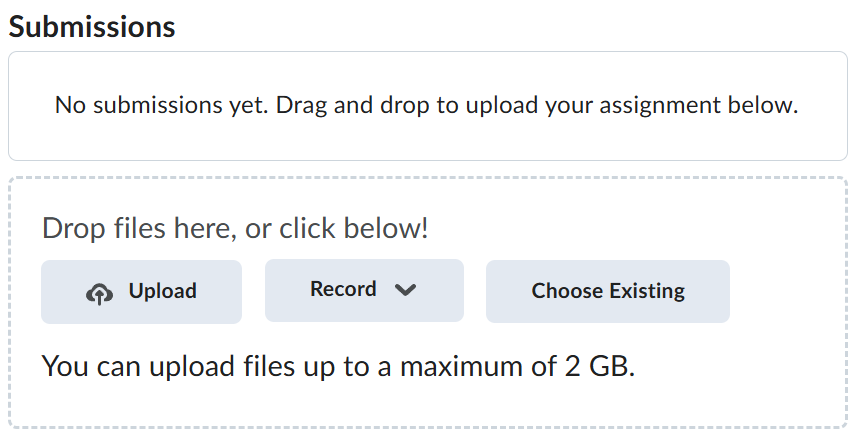
Navigate back to where the lab was originally downloaded, there should be a Submissions section (see below) where the zip file can be uploaded.